TALES BLOG / More Than a Moment: Animal-Assisted Therapy and the Mental Health Crisis
This new blog series explores how Animal-Assisted Therapy offers real, meaningful support in hospitals, schools, and communities, and why connection is never just a small thing.
Across the country, people are carrying a lot.
Stress. Anxiety. Loneliness. Depression. Burnout. Grief. Exhaustion. For many people, these are not rare or temporary experiences. They are part of daily life.
The numbers tell a clear story. According to the Substance Abuse and Mental Health Services Administration, nearly one in four U.S. adults experienced a mental illness in the past year. The Centers for Disease Control and Prevention reports that about one in eight adults regularly experiences feelings of worry, nervousness, or anxiety. Among young people, the picture is just as concerning: recent data shows that one in five U.S. youth reported symptoms of anxiety.
This article is the first installment in a new blog series called The Comfort of Connection exploring the health and well-being challenges affecting people across the United States and here in Alabama, from stress and anxiety to loneliness, burnout, and beyond. In each post, we’ll look at what current research tells us, why it matters locally, and how Animal-Assisted Interventions can be part of a compassionate, evidence-informed response.
Those statistics are national, but the story is local.
Alabama feels it, too.
Mental Health Is a Community Health Issue
Mental health is often treated as something private, clinical, or hidden behind closed doors. But the reality is much bigger than that. Mental health affects classrooms, hospitals, workplaces, families, neighborhoods, and communities.
When people are stressed, anxious, lonely, or emotionally overwhelmed, the impact does not stay neatly contained. It can affect learning, job performance, relationships, physical health, recovery from illness, and the ability to simply get through the day.
In Alabama, frequent mental distress remains a significant concern. America’s Health Rankings reports that 18% of Alabama adults said their mental health was not good for 14 or more days in the past month. The burden is not evenly shared. Frequent mental distress is higher among women, younger adults, people with lower incomes, and people with less formal education.
That matters.
It tells us that mental health is not just about individual resilience. It is also about access, support, environment, connection, and whether people have meaningful resources available when they need them.
The Need Is Growing, and the System Is Strained
At the same time, the behavioral health workforce is under pressure. Federal workforce projections show future shortages across several key behavioral health professions, including mental health counselors, psychologists, psychiatrists, school counselors, addiction counselors, and marriage and family therapists.
That does not mean clinical care is any less important. Quite the opposite. It means we need to think more seriously about the full ecosystem of support around people.
Therapy, medication, crisis care, and psychiatric treatment are essential. But they cannot carry the entire weight alone. People also need connection. They need moments of calm. They need safe, supportive interactions in the places where they already live, learn, work, heal, and receive care.
That is where community-based support matters.
And yes, that includes Animal-Assisted Interventions.
Where Animal-Assisted Interventions Fit
Animal-Assisted Interventions are not a replacement for medical care, mental health treatment, counseling, or crisis services. Full stop. That line matters, and we mean it.
But Animal-Assisted Interventions can be a meaningful complement to care.
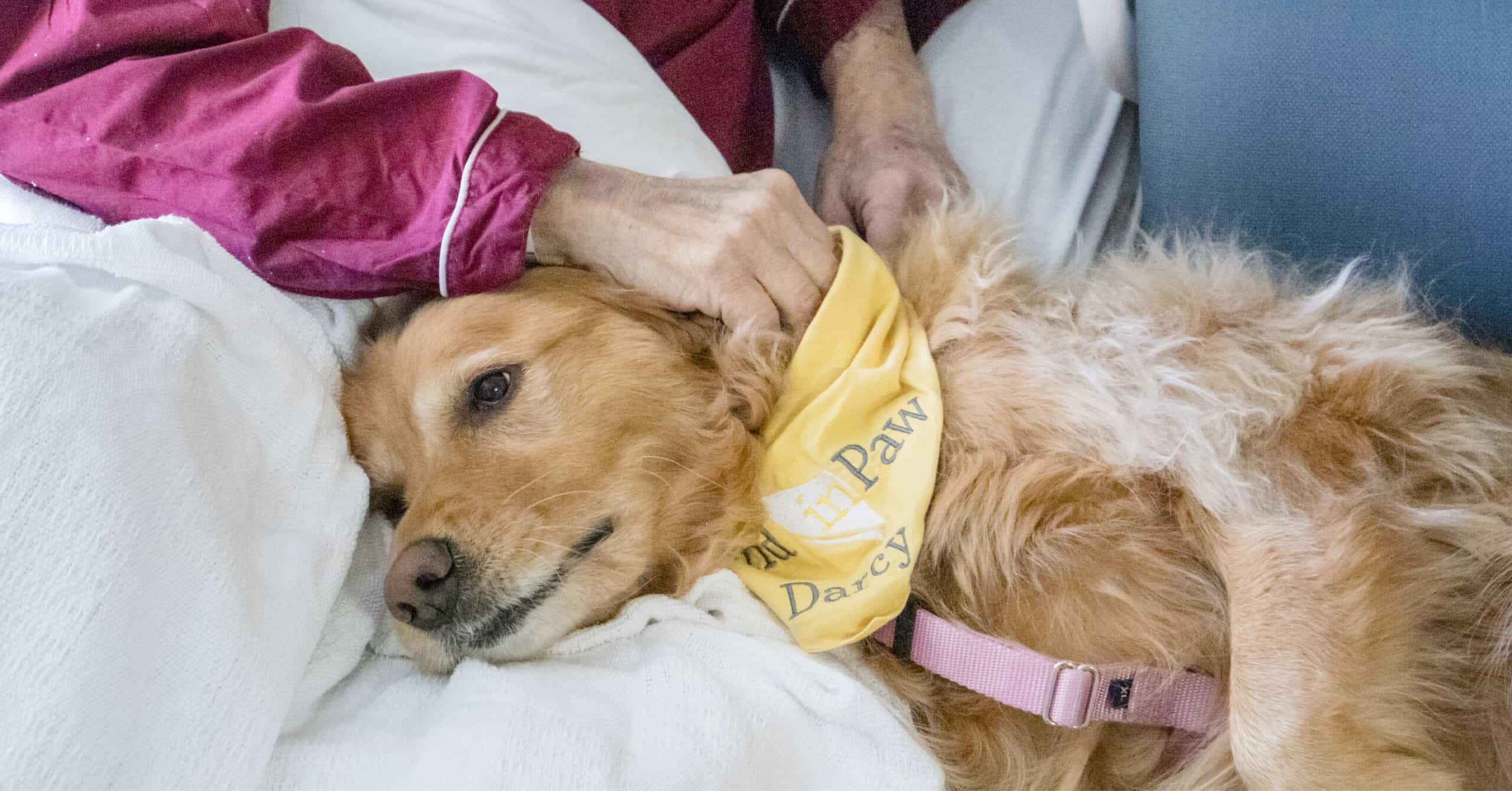
A visit from a professionally trained Therapy Team can create a moment of relief in a stressful hospital room. It can help a student feel more comfortable reading aloud. It can give an older adult a reason to smile, reminisce, or connect. It can offer healthcare workers, teachers, caregivers, and employees a brief but powerful pause in the middle of a demanding day.
Sometimes that is exactly what a person needs: not a lecture, not another form to fill out, not one more thing to manage.
Just a moment.
A calm presence. A soft paw. A friendly face. A reason to breathe a little easier.
That may sound simple, but simple does not mean small.
Connection Is Not a Luxury
In recent years, loneliness and social isolation have been recognized more seriously as public health concerns. That shift matters because it confirms something Hand in Paw Therapy Teams witness every day: connection is not decorative. It is foundational.
People are not machines. We do not heal, learn, work, or cope best in isolation. Human beings need relationships, encouragement, comfort, and belonging.
Animals have a remarkable way of opening the door to those things.
A Therapy Animal can make a hospital feel a little less clinical. A school feel a little less intimidating. A workplace feel a little less tense. A hard day feel a little more manageable.
The animal is not doing the work alone, of course. Animal-Assisted Therapy is a partnership between a trained animal, a trained handler, and the people they serve. The magic is not random. It is structured, intentional, and grounded in care.
Why This Matters for Alabama
Hand in Paw serves communities across North Central Alabama and Tuscaloosa. Our Therapy Teams visit hospitals, schools, universities, senior communities, nonprofits, businesses, and other Program Partners. These visits are provided free of charge.
That last part matters.
When mental health needs are high and access to care is stretched, no-cost community-based services can help fill an important gap. We are not here to replace clinicians. We are here to support people alongside the systems that care for them.
Through our program services, Hand in Paw brings Animal-Assisted Interventions into real-life settings where people may be experiencing stress, anxiety, loneliness, illness, grief, burnout, or fear.
We see it in hospital rooms.
We see it in classrooms.
We see it when a student who is nervous about reading suddenly relaxes beside a Therapy Dog.
We see it when a patient who has barely spoken all day starts telling stories about a beloved pet.
We see it when a staff member kneels beside a Therapy Animal and finally exhales.
These moments do not solve every problem. But they matter.
And in a world where so many people are carrying too much, meaningful moments of comfort and connection are worth taking seriously.
A Healthier Community Needs More Than One Solution
The health challenges facing Alabama and the nation are complex. Stress, anxiety, depression, loneliness, and burnout do not have one cause, and they will not have one solution.
But part of the solution is connection.
Part of the solution is showing up.
Part of the solution is bringing support into hospitals, schools, workplaces, and community spaces before people reach a breaking point.
That is the work Hand in Paw does every day.
In this new weekly series, we will explore some of the major health and well-being challenges affecting people across the United States and here in Alabama. We will look at what current research says, why it matters locally, and how Animal-Assisted Interventions can be part of a compassionate, evidence-informed response.
Because America is stressed.
Alabama feels it, too.
And Hand in Paw is here to help.
Support the Work
Hand in Paw provides Animal-Assisted Therapy services free of charge to our Program Partners. Your support helps bring comfort, connection, and moments of calm to people across North Central Alabama and Tuscaloosa.